The demo runs clean. The AI agent pulls customer records, formats a summary, and hands it back in under four seconds. The developer closes his laptop. Two weeks later, the same workflow fails silently in production. The MCP server it was connecting to has gone offline. There is no error. The agent infers from silence, produces a confidently structured response using nothing, and the output gets routed into a finance report.
Nobody set up an alert. Nobody thought to.
This is October 2026, and the Model Context Protocol registry lists over 43,000 active servers. TypeScript SDK downloads hit 273 million in a single month. Teams across FinTech, SaaS, and HealthTech are wiring their AI agents into this infrastructure as fast as their sprint cadence allows. The pitch is compelling: a standard protocol, a growing ecosystem, connect your agent to any tool and watch it run.
The pitch is accurate as far as it goes. What it leaves out is that the registry is self-declared, the spec is still changing under teams actively shipping against it, and roughly half of the remote servers in that registry will complete a connection today without asking who you are.
What MCP Was Supposed to Solve
Before MCP, connecting an AI model to external tools meant writing custom adapters for every integration. Your agent needed to reach Salesforce, your internal database, a Slack webhook, and a PDF parser, and you needed a different connector for each. That approach is expensive, brittle, and hard to maintain as the tool set grows.
MCP proposed a standard interface. One protocol for all tools, with a server-side implementation that any MCP-compatible client can call. Anthropic built support into Claude. Cursor integrated it. VS Code added it. The idea was that teams could browse a community-built registry and drop any server they needed into their agent stack in minutes.
The theory is sound. The execution is still in progress, and the gap between those two things is where production problems find their footing.
The Registry Is a Claims Database
The official MCP registry is in preview. Its own documentation warns of possible breaking changes or data resets. More important: its listings are self-declared. A server appears in the registry because someone added it, not because anyone has verified it works, stays up, or handles credentials correctly.
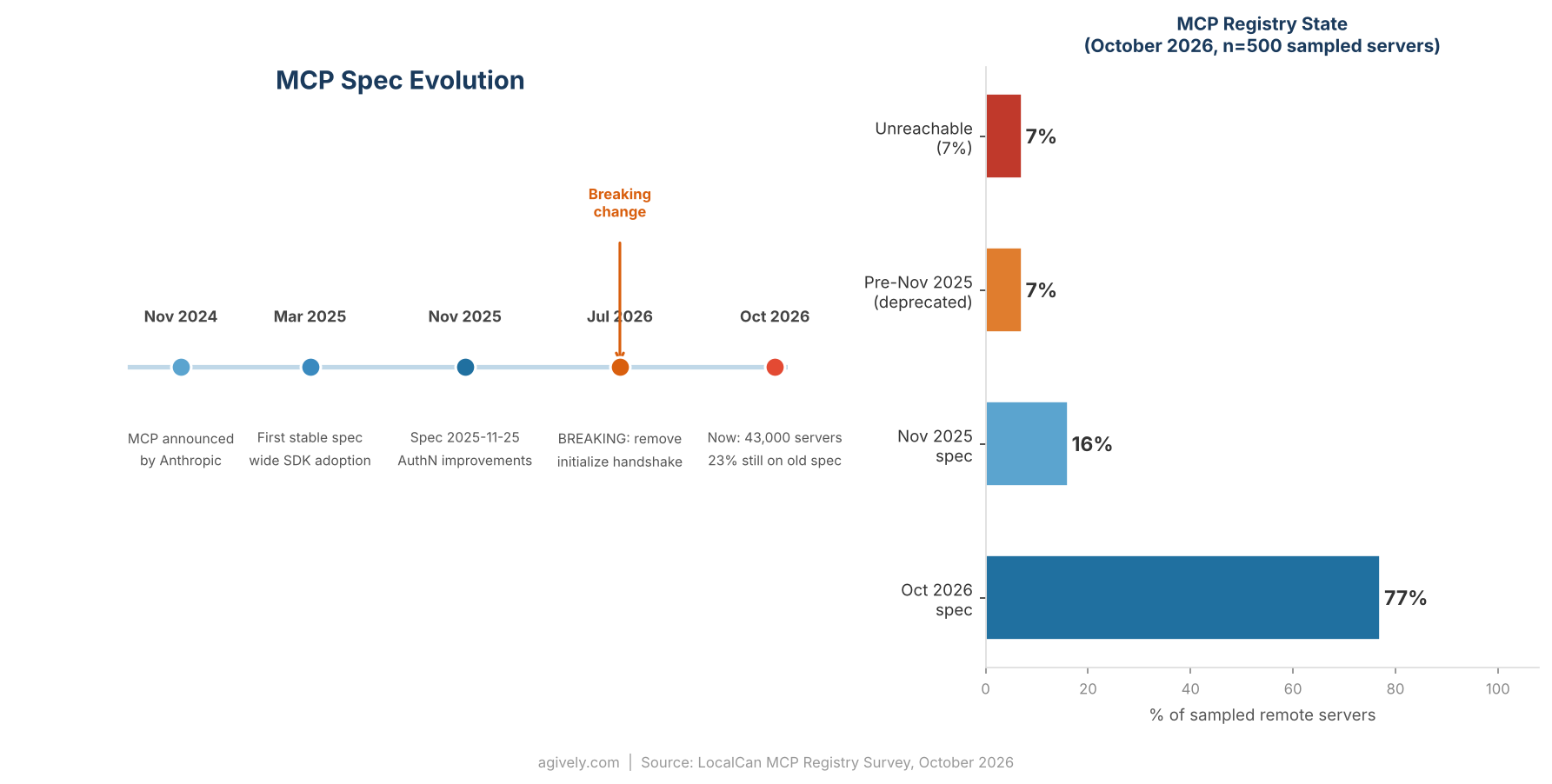
When researchers sampled 500 remote servers from the registry, about 7% returned no answer, a 404, or a server error at their listed URL. These are not edge cases. They are live listings pointing to infrastructure that no longer exists. If your AI-powered development team picks a tool from the registry to power a step in your agent pipeline, roughly 1 in 14 will connect to nothing.
The remaining 93% are reachable. But “reachable” is not the same as “correctly implemented,” and it is not the same as “secure.”
23% Are Speaking a Language the Spec Retired
The MCP spec has been moving quickly. The July 2026 revision removed the initialize handshake, which was central to how clients and servers established sessions. Teams and servers that have not updated still rely on it.
As of this month, 23% of handshakes completing across the registry reported using a spec version older than November 2025. These are not minor version differences. The changes between November 2025 and July 2026 included breaking changes to session handling and transport behavior.
This fragmentation is easy to miss in development. A server built on the 2025 spec and a client using the 2026 revision may complete a handshake, exchange data, and appear to work while silently handling edge cases differently. The failure appears in production, under real load, with unusual input, not in the five-minute demo you ran last Tuesday.
The SDK compounds this. The official TypeScript SDK had a confirmed vulnerability across versions 1.10.0 through 1.25.3: it leaked responses between clients in stateless mode. If your server was deployed within that version window and has not been patched, requests your agent sends may be visible to another client sharing the stateless session. This is not a theoretical risk in a lab. It is a documented vulnerability in the tool most teams are using to build.
Half the Servers Answered Without Asking Who You Are
When researchers sampled those 500 remote servers and attempted unauthenticated connections, 52% completed the handshake. The connection went through. No credentials required.
That number is an upper bound. Some servers may check credentials only when a specific tool is called, not during the handshake itself. But for the teams connecting those servers into workflow automation pipelines that touch customer data, internal records, or financial systems, the question “who else can reach this tool and what can they call?” needs an answer before you ship, not after.
The OAuth story is not much better. About 39% of servers returned a 401 and pointed to OAuth metadata, which is the correct behavior for a properly authenticated server. But OAuth implementation quality varies widely across the registry, token handling differs between implementations, and the spec guidance on authorization is still developing. Enterprise teams expecting to tie MCP integrations to their corporate identity systems, with audit trails and role-based access control, will find that infrastructure largely undefined.
A team doing an honest security review before connecting a third-party MCP server to their agent pipeline needs to answer: who built this, are they still maintaining it, what spec version does it implement, how does it handle authentication, and what data can it access? The registry answers none of those questions. It provides a URL.
The Silent Failure Problem
Return to the opening scenario. The agent produced a confidently structured output when its underlying tool had failed and returned nothing. That pattern – an agent inferring from absence and presenting the result as real – is not a corner case in agentic systems. It is the default behavior unless you build explicit failure detection around every tool call.
MCP servers fail silently more often than they should. Error quality depends entirely on who wrote the server. Some return detailed diagnostics. Others return opaque stack traces that tell the agent nothing actionable. Some return nothing at all. When your pipeline is an agent calling a sequence of tools and one fails silently partway through, the agent does not always stop. It continues with whatever partial state it has, and the output looks plausible.
This is part of what surfacing in an AI consulting engagement looks like before it becomes a production incident: not whether the tools work in isolation, but what the agent does when they do not, and whether the system can tell the difference. The accuracy implications are not abstract. A pipeline with ten tool calls, each failing roughly 5% of the time, completes the full sequence correctly only about 60% of the time. Add a tool that fails without reporting it, and you lose even that signal.
What This Actually Requires
None of this is an argument against MCP. The protocol addresses a genuine problem. The ecosystem is growing fast, SDK adoption is 8x year over year, and the core maintainer group is actively working on horizontal session scaling, better async task handling, and enterprise authentication. The direction is right.
But “the direction is right” and “this is ready to drop into a production agent stack without additional review” are different claims. The current state of the registry and the spec suggest treating MCP integrations with the same scrutiny you apply to any third-party dependency that handles data or executes actions in your systems.
Verify every server independently before connecting it. Check the spec version it implements. Attempt both an authenticated and an unauthenticated connection. Look for recent commits or maintenance activity. A server that has had no updates in six months and was built on a deprecated spec version is a liability, not a time-saving shortcut.
Build explicit failure handling into every tool call, not as an afterthought. Silent failures need to surface loudly. Agents that infer from nothing should produce a detectable error state, not a plausible-sounding result.
Treat MCP authentication the same way you treat any external API key. Scope what each server can access to the minimum required for its function. A server that accepts an unauthenticated handshake and checks credentials only on specific tool calls is only as secure as its weakest callable endpoint.
Pin your SDK versions and treat the changelog as required reading before any update. The TypeScript SDK vulnerability was patched. But staying current on security patches while avoiding breaking changes in a fast-moving spec is an active process, not something you can set up once and ignore.
The teams that build reliable MCP-based systems are not the ones moving fastest through the registry. They are the ones treating the registry as a starting point for evaluation rather than a list of safe defaults.