The invoice came on a Thursday. The startup had shipped their AI customer support assistant six weeks earlier. The pilot with 50 beta users had run smoothly. Token costs tracked exactly with the estimate the engineering lead had presented. The board had signed off. Real launch went live three weeks ago.
The API bill for the first month of real production: $14,200.
The budget: $3,000.
User count was up 2.4x from the pilot. Token consumption was up 11x.
Nobody had touched the code. Nobody had changed the prompts. The model was the same. The only thing that changed was real users, in real conversations, doing real things.
What they were looking at had a name, even if they didn’t know it yet. Call it the scaffolding tax.
What “Context Window” Actually Means in Practice
The model vendor sells you a context window. As of late 2026, that number is impressively large. One million tokens. Two million. The marketing language implies a kind of abundance.
What the marketing doesn’t mention is what fills that context window before you get to the conversation that your user is actually having.
In a production AI application, every request to the model carries invisible cargo. Here is what a typical customer support or document assistant sends before the user’s actual message:
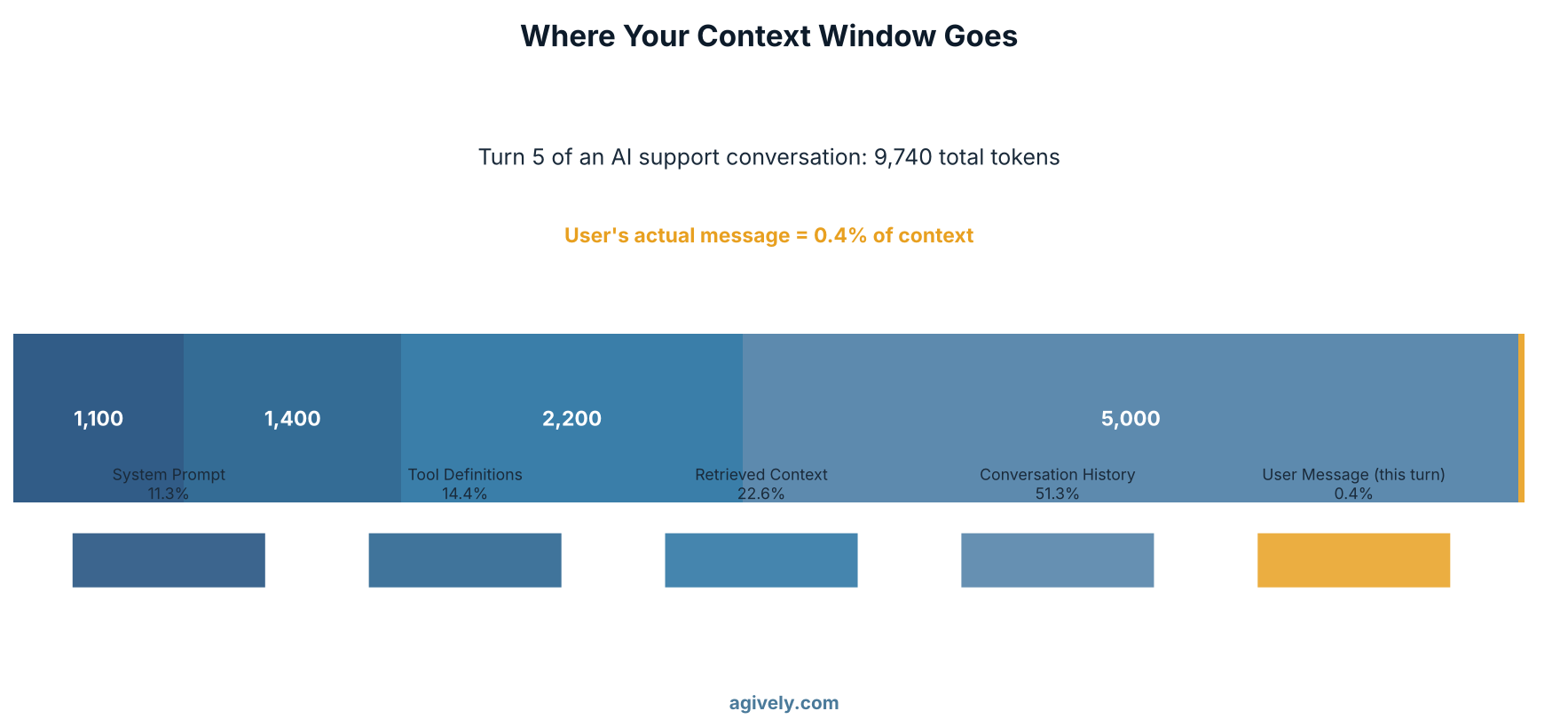
A system prompt. This is the foundational instruction set that tells the model who it is, what it can and cannot do, how to format responses, what tone to use, and what edge cases to handle. In a production application with enough thought put into safety and accuracy, this prompt often runs 800 to 1,500 tokens. Teams that built quickly sometimes have prompts twice that length, especially if they added guardrails incrementally each time something went wrong.
Tool definitions. If the assistant can call functions, look things up, or take actions, every tool definition has to live in the context. A support assistant with the ability to search the knowledge base, check order status, escalate to a human, and log feedback might carry 1,000 to 2,000 tokens in tool schemas alone, even if the user never triggers a tool call.
Retrieved documents. For any RAG-based application, the retrieved chunks land in the context before the model sees the user’s question. A system that retrieves three to five documents at 500 tokens each is adding 1,500 to 2,500 tokens of retrieval context per request. Many retrieval systems, especially ones built quickly during a proof-of-concept, retrieve more than necessary because they were never tuned for precision.
And then, the conversation history. The first user message arrives, the model responds. Now both are in the context for the next turn. By turn 5 of a conversation, you are carrying the full history of the exchange in every single request. By turn 10, that history alone can exceed 4,000 to 6,000 tokens.
Add it up for a mid-length support conversation. The scaffolding, the system prompt, the tools, the retrieved documents, and the conversation history can consume 7,000 to 12,000 tokens per request by turn 5. The user’s actual new message in that turn might be 40 tokens.
The model is spending 99.6% of its attention on infrastructure.
The Staging Trap
Here is why this doesn’t surface during prototyping.
Your staging environment runs 20 or 30 test conversations. Those conversations are short. They are probably written by your own team, so they are concise and to the point. The retrieved documents are from a small test dataset, so the retrieval is clean. And the conversations don’t go very long, because nobody on your team is using the tool the way a frustrated real customer will.
A test user asks three questions. A real user asks twelve.
In staging, your average conversation is 2 to 3 turns. In production, your average conversation is 5 to 8 turns, with a long tail of conversations that run to 15 or 20 turns before resolution. Each turn in a long conversation is dramatically more expensive than the previous one, because every new turn carries the full history of everything that came before it.
The cost model you built from your staging tests treats every conversation as roughly equivalent to your test conversations. It is probably off by a factor of 3 to 5 on the per-conversation cost. And that underestimate compounds with every real user who stays in the conversation longer than your test users did.
The dev-to-prod cost shock is real, and it is predictable in retrospect. The teams that model it correctly before launch are the ones who explicitly think about their conversation length distribution, not just their average cost per message.
Why the Fix Is Not “Bigger Context Window”
The natural instinct, when you first see this problem, is to wonder whether a bigger context window solves it. It doesn’t. It reframes the question.
A larger context window means more capacity to hold the scaffolding. It does not reduce the scaffolding itself. If anything, teams with access to larger context windows tend to add more to their system prompts, more tools, and more retrieved content, because the capacity seems abundant. The result is higher costs per request, not lower ones.
The other instinct is to assume that the token price will fall fast enough to make this manageable. Token prices have been falling, and will likely continue to fall. But production usage scales with users. If your user count grows 10x and your per-token cost halves, you are still 5x over your original budget. The math doesn’t save you.
The fix is architectural, and it has four parts.
Compression. Your system prompt almost certainly has redundancy. Instructions that repeat themselves. Formatting notes that could be much shorter. Guardrails that are phrased at length because someone added them in a hurry. A prompt compression pass, done by a human who understands both the requirements and the token economics, often reduces system prompt length by 30 to 50 percent without losing any behavior. This is not glamorous work. It is also one of the highest-return things you can do in a production AI application.
Precision retrieval. Most retrieval implementations in early-stage AI products retrieve too much. The retrieval was set up with generous thresholds to avoid missing relevant content. In production, the cost of imprecision shows up in the bill. Improving retrieval precision, pulling fewer but more relevant chunks, reducing the average retrieved context size by 40 percent, is a meaningful win. This is part of what good AI-powered development looks like in practice: the POC ships with broad retrieval. The production system ships with tuned retrieval.
Context pruning. Conversation history does not need to be carried verbatim and in full. Techniques like conversation summarization, where you replace the early turns of a long conversation with a compressed summary, can cut the history token load in half for long conversations. This is especially impactful on the tail of your conversation length distribution, the long conversations that are disproportionately expensive.
Model tiering. Not every request needs your most capable and most expensive model. A routing layer that sends short, simple queries to a lighter model, and reserves the expensive model for genuinely complex requests, can materially reduce the average cost per conversation without degrading the user experience for cases that need full capability. This is a form of workflow automation that most teams don’t think of as automation, but it functions the same way: a decision engine that routes work to the right resource based on the complexity of the task.
The Number Nobody Models at the Start
When teams pitch an AI feature internally, the cost model usually shows a per-user or per-conversation cost based on average token counts from a small test set. That number lands in the spreadsheet and becomes the planning figure.
What is almost never modeled is the shape of the actual usage distribution. The fact that 20 percent of your users will have conversations three times as long as the average. The fact that your most engaged users, often the ones who provide the most value as customers, are the ones driving the heaviest API bills. The fact that the system prompt you have today will be three times as long by month six, because you will have added language to handle every edge case that comes up.
Good AI consulting surfaces these questions before the product ships, not after the first bill arrives. What is the realistic conversation length distribution for this use case? What is the expected growth rate of the system prompt? How does the cost model hold at 10x users? These are architecture questions as much as they are finance questions, and the answers should be baked into the technical design from day one.
The scaffolding tax is not a gotcha. It is an entirely foreseeable consequence of how production AI applications are built. The teams that get surprised by it are the ones who projected their staging behavior onto their production usage. The teams that handle it well are the ones who modeled the production environment specifically, designed with token economics in mind, and built the compression, pruning, and routing infrastructure as first-class concerns rather than afterthoughts.
There is nothing about this that is new. Every time an engineering discipline gets cheap enough to use casually, the costs move to the next layer. When compute got cheap, the cost moved to storage. When storage got cheap, the cost moved to bandwidth. Now that tokens are cheap enough to prototype with freely, the cost is moving to the scaffolding that wraps them. The tax doesn’t go away. It just gets better hidden.
You will find it. The question is whether you find it on your own terms, or on the first bill that arrives three months after launch.