The founder thought the server needed an upgrade. Pages were loading in 30 seconds at 500 users. The site kept timing out. She spent two months troubleshooting hosting plans and upgrading from $20 to $200 a month before she finally called a developer.
The actual problem was three lines of code. The app was making 8,000 database queries every time someone loaded the homepage. An AI tool had written the data-fetching logic and nobody had read it closely enough to notice. The fix took an afternoon. The two months of stress and $3,600 in unnecessary infrastructure costs were not refundable.
That startup’s story is not a horror story about AI coding tools. It is a story about a gap between building something and understanding what you built.
The Bet Everyone Has Been Making
Something real changed in 2024 and 2025. Non-technical founders, solo operators, and early-stage product teams started shipping production apps using AI coding tools and got results faster than anyone expected. A feature that once required a backend developer and two weeks of calendar time now took a weekend. Investors stopped asking whether a founder could code. They started asking what they had already shipped.
By the end of 2025, roughly 10,000 startups had built production applications primarily through AI-assisted “vibe coding” — describing what they wanted and letting the model write the code. The speed gains were genuine. Some of those teams reached market six months ahead of where they would have been with a traditional development approach.
The bet most of them made, either consciously or not, was this: we will clean it up later.
That bet is coming due now.
What Happens Around Day 90
About ninety days after a team ships their first vibe-coded product, a pattern appears. Not always at exactly ninety days. Sometimes sixty. Sometimes four months. But the timing is consistent enough that engineers who do rescue work have started using the term as shorthand.
Someone opens a function to fix a small bug. The function is 300 lines long. It handles form validation, database writes, an email notification, and some business logic that references a constant defined five files away. Changing one line carries a real chance of breaking something in a completely different part of the app. Nobody is certain which part.
The founder who built the app cannot read the code. The AI that generated it is stateless and has no memory of what it intended. There is no documentation because the app came into existence too fast for documentation to feel necessary. The test coverage is thin or nonexistent because the AI tools that wrote the code did not automatically write the tests that would have caught the edge cases.
At this point, most teams do one of two things. They bring in an engineer to stabilize the codebase — which takes longer and costs more than they expected — or they keep building on top of the shaky foundation and hope the problems stay manageable. Most choose the second option, at least initially. The next feature is always more visible than the risk underneath the last one.
That choice is what turns a fixable problem into a rebuild.
The Numbers Behind the Pattern
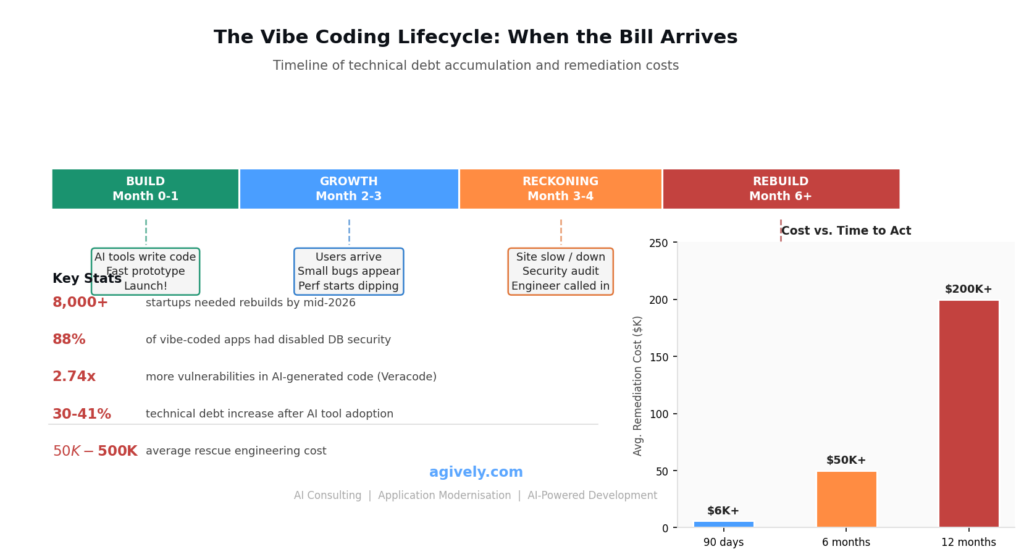
By mid-2026, more than 8,000 of those 10,000 startups needed either a partial rebuild or rescue engineering to keep operating. Community reports peg the cost of professionally rebuilding a vibe-coded application at $5,000 to $30,000 on the low end. For apps that have scaled, the average rescue cost runs between $50,000 and $500,000, depending on how far the technical debt has grown into the app’s structure. When governance and proper architecture have to be retrofitted after the fact, rebuild costs typically exceed the original development budget by 3x to 5x.
A large-scale study of 8.1 million pull requests found that technical debt increases 30 to 41% after AI coding tool adoption. The debt concentrates in predictable places: missing error handling, duplicated logic, and functions that work under the specific conditions they were tested in and break unexpectedly when those conditions change.
The security side of this is arguably the more urgent problem. Research auditing vibe-coded apps in early 2026 found that 88% had database row-level security either misconfigured or entirely disabled — not as a conscious trade-off, but because the AI tool that set up the database simply did not flag it as something that needed attention. Veracode’s testing of over 100 large language models found that AI-generated code contains roughly 2.74x more vulnerabilities than human-written code. In March 2026 alone, 35 CVEs were directly attributed to vulnerabilities introduced by AI-generated code. In January of that same year, the count was six. What Vibe Coding Doesn’t Build digs into exactly what that security gap looks like up close.
Production incidents per pull request increased 23.5% between December 2025 and early 2026. These are not hypothetical risks. They are incidents that have already cost companies data, customers, and in some cases, their compliance standing.
The Opacity Problem
The reason these issues are hard to fix is not that the underlying code is irreparably broken. The reason they are hard to fix is that nobody can read it well enough to know where the actual risks live.
When a developer writes a function, they at minimum understand what they intended it to do. When an AI writes a function and a non-technical founder ships it without review, the code exists as a black box that happens to work under the conditions it was tested in. Change those conditions — more concurrent users, a different input format, a library update, a user who clicks something in an order the AI never anticipated — and the failure arrives without context or warning.
This is what makes vibe-coded debt different from traditional technical debt. Traditional technical debt is usually visible to anyone who reads the code. A developer can look at a messy function and estimate how long a cleanup will take. With AI-generated code that no human has reviewed, the debt is invisible until something breaks. And when something does break, diagnosing it requires understanding code that nobody on the team wrote or fully owns.
Only 3% of developers highly trust AI-generated code. 71% refuse to merge it without manual review. The developers who work with these tools every day have absorbed a lesson that founders building on top of AI-generated code often have not: the output is a starting point, not an endpoint.
The Version of This Story Nobody Tells
The conversation about vibe coding tends to split into two camps. One insists it has transformed who can build software and that the productivity gains are real. The other insists it is producing a generation of unmaintainable apps that will collapse under real-world usage. Both camps are accurate about what they observe. Neither is giving you the full picture.
Here is what the data shows: vibe coding is a powerful first gear. It moves you from idea to working prototype faster than any other approach available today. What it does not give you is a second gear.
The teams that avoid the reckoning are not the ones who avoided AI tools. They are the ones who treated AI-generated code as a first draft rather than a finished product. They had an engineer review what the model wrote before it shipped. They ran a security audit before launch, not after the breach. They kept functions small enough that a human could read and understand them. They wrote tests.
None of that is exotic engineering practice. It is the baseline discipline that experienced developers learned to apply over decades of seeing what happens when you skip it.
What Actually Helps
If you are operating a product built primarily on AI-generated code, the most valuable thing you can do before making any significant business decisions is get an honest technical audit. Not a vendor sales conversation. An audit that maps where the security gaps are, identifies which parts of the codebase are brittle under load, and tells you honestly how much of what exists is worth keeping versus rebuilding from cleaner foundations.
Application modernization is not always a full rewrite. More often it is targeted work on the three or four functions that carry the most risk: adding proper authentication layers around code that assumed users could be trusted, introducing real error handling where the AI tool left optimistic gaps, and refactoring the functions that nobody can currently change safely.
If your team is still in the build phase and using AI tools as a core part of the development workflow, AI consulting done well tells you how to build inside a process that includes review and testing — not as bureaucratic overhead, but as the thing that keeps the productivity gains from compounding into liabilities. And if you need engineering capacity to execute on what the audit recommends, AI-powered development with senior engineers in the loop gives you the speed of AI tooling with the judgment that those tools cannot supply on their own.
The goal is not to slow down. It is to keep moving fast without building up a debt that eventually forces you to stop entirely.
The Honest Position
Vibe coding will not go away. The tools are improving. The workflows around them are maturing. The early cohort of startups that shipped without guardrails is paying tuition that later cohorts will likely avoid — not because they are more disciplined, but because better practices are developing around these tools and being shared openly.
What that does not change is the current situation. If you have a production application built primarily by AI tools that has not been reviewed by an engineer with security and architecture in mind, you are holding a liability you cannot yet fully quantify. The size of that liability grows every month you add users and functionality on top of a foundation you do not completely understand.
The ninety-day reckoning is not inevitable. But avoiding it requires an active choice, and that choice gets more expensive the longer you wait to make it.