The demo went perfectly. You had eight people in the room and a Loom link ready for the two who couldn’t make it. The agent handled every scenario you threw at it. Routed the support ticket in under two seconds. Drafted the compliance summary in eleven. It caught the edge case that had been tripping up the team for three weeks, and when someone said “this is going to change everything,” nobody pushed back.
That was a Thursday. By the following Tuesday, you had three user complaints, two incorrect outputs that had already gone downstream into reports, and an error log that said nothing useful because the agent doesn’t log what it doesn’t know is wrong.
The agent was still running, technically. It just wasn’t doing what you thought it was doing.
The 80% Problem Is Not a Bug. It Is a Boundary.
In January 2026, developer Addy Osmani put a name to something engineering teams had been experiencing for months. He described AI agents as reliably solving roughly 80% of any given task. Not 79, not 81 — a consistent 80%. The remaining 20%, which covers error handling, rate limiting, retry logic with backoff, circuit breakers, audit logging, PII redaction, and input sanitisation, is where the model starts improvising.
The problem is not that an AI agent cannot write error-handling code. It can. The problem is that it doesn’t know when the code needs to run, because the demo environment never produced the conditions that would trigger it.
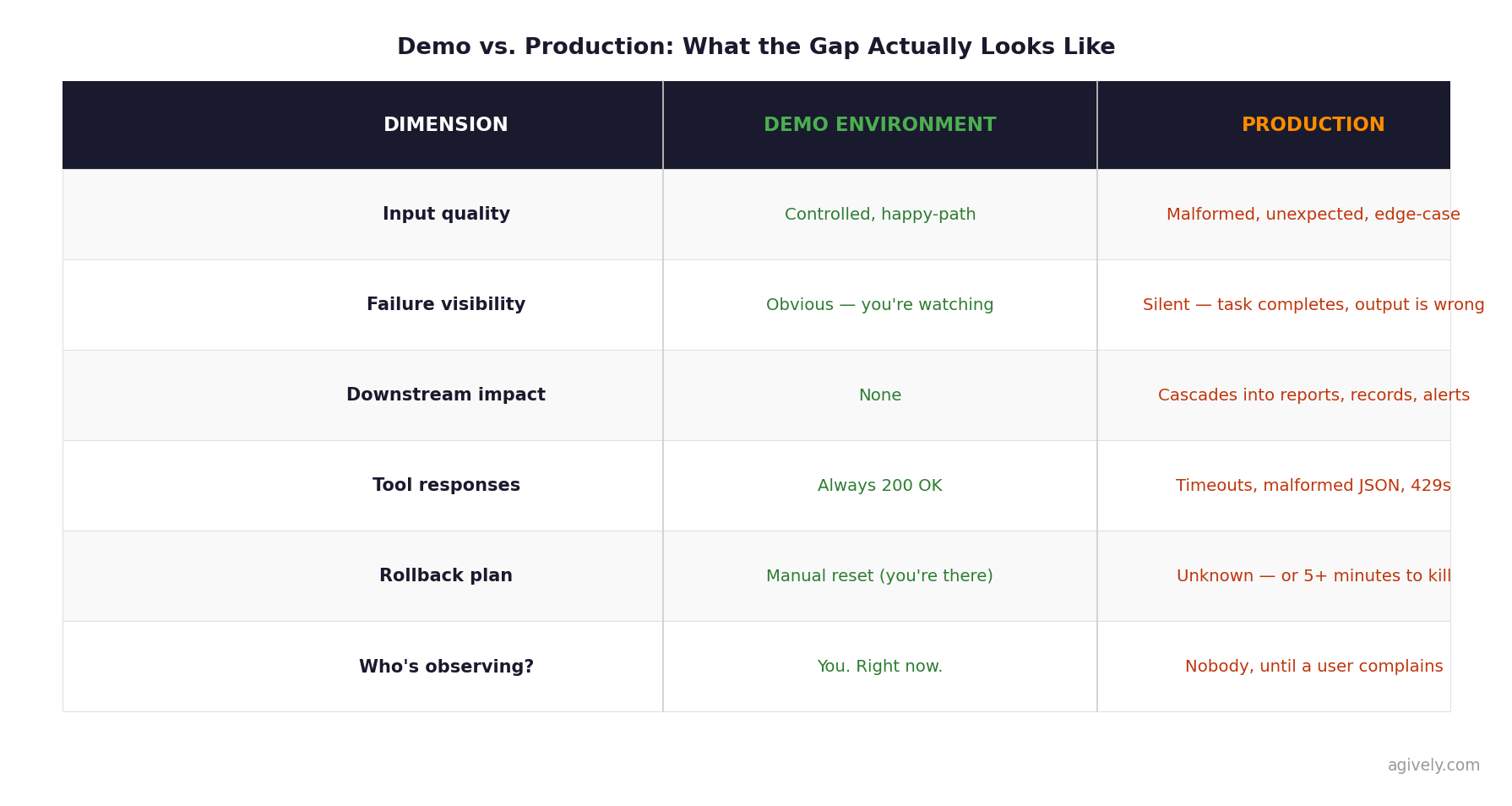
Production does not run on happy paths. It runs at 3am when a downstream API times out, when a user submits a field that is technically valid but structurally unexpected, when a third-party service returns a 200 status with JSON your schema cannot parse. These are the conditions that reveal whether your agent is production-ready or just demo-ready.
Most are demo-ready. The distinction matters enormously.
What the Numbers Actually Say
According to a 2026 Gartner analysis, 70% of organisations that have shipped agentic AI systems expect to significantly rebuild or rearchitect them within the next 12 to 18 months. Sixty-four percent say they deployed agents faster than their teams felt prepared to support. And a Stanford HAI report from mid-2026 found that up to 40% of agent failures in production are silent: the task completes, an output is returned, and it looks plausible to anyone who is not comparing it against ground truth.
That last number is the one that should produce genuine discomfort.
A noisy failure is manageable. You get paged, you fix it, you write the post-mortem and move on. A silent failure is an invoice processed with the wrong amount, a customer record tagged incorrectly, a compliance report with a confident-sounding hallucination that nobody catches until an auditor does. By then the agent may have been running for six weeks, and you have no trace of why it made the decisions it made, because it never told you it was uncertain.
Incidents without reasoning traces have an average mean time to resolution of over four hours, according to 2026 observability platform data. With full decision trace logging in place, that drops to under an hour. The trace is not a nice-to-have. It is the difference between a resolved incident and a four-hour investigation into a black box.
Why Teams Ship Anyway
This is not a story about carelessness. Most of the engineering leads I have spoken with who shipped agents with observability gaps knew the gaps were there. They shipped anyway, because the prototype had convinced leadership, the competitive pressure to move was real, and “we’ll close that in the next sprint” felt like a reasonable trade-off in the moment.
It almost never is. Not because the engineering team made a bad call, but because sprints fill up and the 20% that was always the least visible work stays invisible until production makes it visible for you.
The debt compounds. Every week an unobserved agent runs in production is a week of decisions you cannot audit, errors you cannot attribute, and user trust you cannot rebuild once it erodes. The teams that end up rearchitecting from scratch in month 12 are not teams that made one catastrophic decision. They made a series of small, individually defensible decisions that together added up to a system nobody can confidently say they understand.
Gartner has already predicted that a remediation market will emerge for this category of problem: specialised consulting and tooling to audit, identify, and refactor AI-generated technical debt. That market exists because the debt is already accumulating, and it is doing so quietly.
What Production-Ready Actually Requires
The teams that get agents into production without creating a debt spiral have converged on something that looks less like prompt engineering and more like traditional software engineering applied to a new context. A few patterns show up consistently.
Scoped, typed tool access. Rather than giving the agent broad permissions to call whatever services are available, they define a small set of well-typed actions, each one logged, rate-limited, and reversible where possible. If the agent writes to a database, it writes to a staging log first and a validator, human or automated, approves the transaction before it commits. The scope of autonomy matches the confidence level of the system. An agent you cannot confidently monitor should not be autonomously updating records.
External telemetry, not self-reporting. You cannot rely on an agent to accurately describe its own failures. The most expensive failures, the ones where the model encounters an unexpected response and improvises rather than throwing an exception, are precisely the ones that self-reporting will miss. External observability infrastructure captures state transitions and tool-call outcomes independently of the agent’s own logs. When something goes wrong, you have a trace that shows you the reasoning steps, not just the final output.
Testing unhappy paths before launch. This sounds obvious. It is not the practice at most teams moving fast. Load testing with malformed inputs, testing what happens when a downstream API returns a 429 or a timeout, testing the agent’s behaviour when it receives a structurally unusual but technically valid input: these are the tests that define the 20% boundary. They are also the tests that teams under pressure consistently defer. For teams in FinTech or HealthTech, where a misrouted record or an incorrect calculation carries regulatory consequences, deferring these tests is not a judgment call. It is a compliance risk that arrives without warning and without a grace period.
This is where most of the real engineering time goes when AI-powered development is done properly. Not on the demo. On the question: what does this system do when it gets the input it was not designed for? That question produces different software than “does this impress in a walkthrough?” produces.
If you are working through this with a team that has not done it before, a structured AI consulting engagement that begins with operational readiness rather than capability exploration tends to surface the right questions early. Where does the agent log its decisions? What is the kill switch? Who owns the alert? What is the rollback procedure? These are not glamorous questions. They are the questions that determine whether your agent is a feature or a liability.
The Rollback Question
Here is a concrete diagnostic. If your AI agent produced incorrect output right now, how long would it take your team to disable it?
If the answer is more than five minutes, that is useful information. If the answer is “I’m not sure,” that is a problem worth addressing before production surfaces it for you. Thirty-six percent of organisations in a 2026 enterprise AI adoption study cannot roll back a failing agent within minutes of identifying the issue. Most of them discovered this mid-incident.
Context engineering, the practice of carefully shaping what an agent draws from when making decisions, is one layer of this. We covered it in detail in an earlier post: Your AI Agent Isn’t Dumb. Your Context Is. But context alone does not solve the operational readiness gap. Even a well-contextualised agent needs monitoring, rollback procedures, and a clear answer to “who is responsible when this produces the wrong output?”
The Part Nobody Talks About in the Demo
AI agents in production are not a mistake. The 22% of teams whose agents actually reach production and stay there, without requiring a full rearchitect at the six-month mark, are getting real value from them. Faster document processing. Consistent ticket routing. First drafts that would otherwise take a junior analyst 40 minutes. The productivity gains are genuine and material.
The gap between those teams and the ones rebuilding in month 12 is not intelligence, resources, or access to better models. It is mostly discipline. Specifically, the discipline to treat the last 20% of any AI system as first-class engineering work, not cleanup, not a sprint backlog item that keeps getting pushed, but a mandatory part of the definition of done.
If you have built something, got the demo working, and shipped it — that is a start, not a failure. The question now is whether you are observing what it is actually doing, whether you can disable it in under five minutes if you need to, and whether the 20% of edge cases it was never designed for has a plan. That work is less exciting than the demo. It is considerably more important.
And if you are not sure how to assess where your system sits on that spectrum, that is a conversation worth having before production makes the assessment for you.