It was a Monday morning incident review. The team had spent the weekend testing a four-agent pipeline: planner, researcher, coder, reviewer. Each agent had a clear job. The tests ran clean. On Friday, they deployed to production. By Monday, a fintech client had found that the system was calculating transaction fees using the wrong rounding logic. Not dramatically wrong. Just quietly wrong enough to matter.
The post-mortem took three hours. The planner agent had produced correct requirements. The final code was syntactically valid. The reviewer had flagged nothing. But somewhere in the handoff between the planner and the coder, the specific constraint that governed the rounding logic had evaporated. Nobody could reconstruct what context the coder had actually received. The agents had no shared memory. The handoffs had no receipts. There was no trail to follow.
This is the handoff problem. And it is quietly ending the careers of multi-agent systems that looked great on demo day.
The jump from one agent to many
One agent is a tool. It receives input, processes it, returns output. When it fails, you debug a tool: check the input, check the prompt, check the output. The failure surface is defined and contained.
Five agents communicating through a pipeline is not five tools. It is a team. And teams fail in a completely different way. They fail at the communication layer, at the moments of transition, at the boundaries where one agent’s output becomes another agent’s input. The models can be excellent and the system can still produce garbage, because the coordination structure was never designed.
This distinction is obvious in retrospect. It is invisible to most teams until the first production incident.
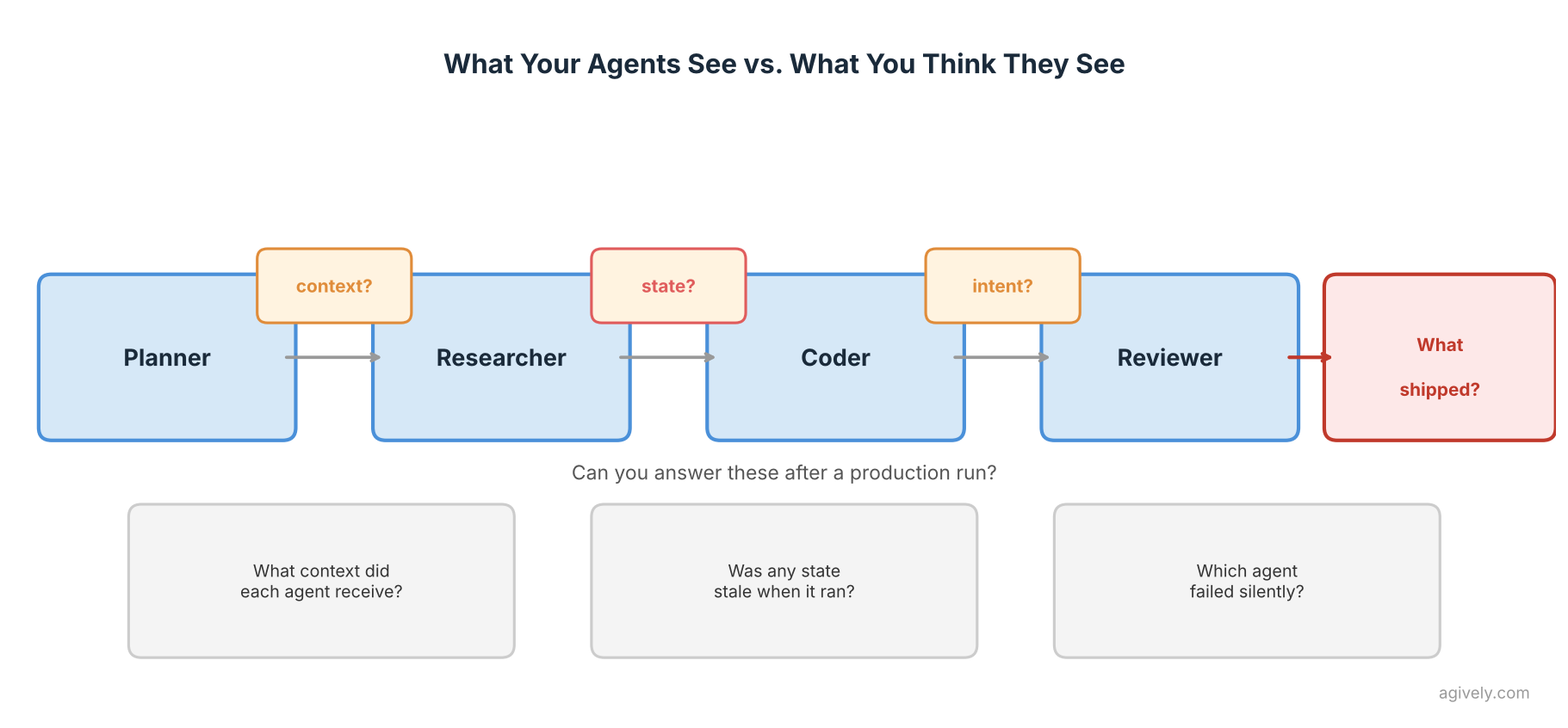
The three places it breaks
Multi-agent systems fail in predictable patterns. Teams that have shipped them and debugged them report variations on the same three problems.
Context evaporation. Agent B starts its task with a subset of what agent A knew. This is not a bug in agent B. It is a consequence of how the handoff was designed. If agent A passes only its final output and not its reasoning, agent B has less to work with than the person who wrote the requirements intended. In a simple pipeline, the information loss accumulates with each step. By the time the fourth agent runs, it may be working from a summary of a summary of the original specification.
Stale state. In a production system, agents often run in parallel or on delay. The context that was accurate when agent A ran may no longer be accurate when agent C picks up the work several minutes or hours later. Database states change. External API calls return different results. Documents get updated. If the system does not track when context was captured and what it reflects, an agent can make confident decisions using information that has already expired.
Orphaned failures. When an agent in the middle of a pipeline fails, the system often silently routes around it or falls back to a default. The downstream agents continue. The final output is produced. No alarm fires. The failure was real, it changed the result, and nothing in the audit log makes it visible. Orphaned failures are the hardest ones to catch, because the system technically completed.
These three failure modes are not framework problems. Switching from LangGraph to CrewAI to AutoGen does not fix them. They are coordination infrastructure problems, and they require a different kind of thinking.
What coordination infrastructure actually means
The phrase “coordination layer” gets used in architectural discussions as if it refers to a specific tool or pattern. It does not. It refers to a property your system either has or does not have: the ability to track, preserve, and inspect the state of communication between agents.
A system with coordination infrastructure can answer these questions after any run:
What context did each agent receive, in full, before it began work? Not what you intended to pass, but what it actually received.
What was the state of the world at the moment each agent ran? Not the state at deployment, but the live state when that specific invocation started.
If agent three failed or produced unexpected output, what did it see that explains why?
Can you replay the pipeline from agent two onward without re-running agent one, using the same context agent two originally received?
Most teams building their first multi-agent system cannot answer any of these. They have output logs. They have final results. They do not have durable handoff state. When something goes wrong, they are debugging in the dark.
This matters especially in sectors where the cost of a silent, wrong output is high. A FinTech pipeline that generates fee calculations, a HealthTech system that surfaces clinical recommendations, a SaaS workflow that modifies account data: none of these can rely on “it probably worked.” They need a system where “it worked” and “we can verify that it worked” are the same statement.
The verification tax everyone forgot to budget for
There is a subtler version of this problem that shows up not in production failures, but in the ongoing cost of running multi-agent systems safely. A 2026 controlled study on AI-assisted development found that experienced developers using AI tools took 19% longer to complete tasks than developers working without them. The researchers called it a verification tax: the time spent reading generated output, reconstructing intent, and catching plausible-but-wrong work.
The same dynamic scales into multi-agent systems. When you cannot trust the pipeline implicitly, you are always partially debugging it. Senior engineers spend time inspecting intermediate outputs they should not need to inspect. Teams add review steps that negate the velocity benefit the agents were supposed to provide. The agents are fast. The verification overhead is slow. The net effect is not what anyone projected on the whiteboard.
The teams that break this pattern are the ones that invest in verifiability before they invest in scale. They start with two agents, not six. They build the coordination state store before they add the third agent. They treat the handoff as a first-class artifact, not a side effect of running the pipeline.
For companies looking to build AI-powered development workflows that hold up at scale, this sequencing is not optional. Getting the coordination layer right on a small system is far less expensive than retrofitting it after the first production incident on a large one.
Agents as a team, not a collection of tools
The mental model shift that changes everything is treating multi-agent systems the way you treat a development team, not the way you treat a function call chain.
A development team has communication protocols. When one person hands work to another, there is context: a written brief, a Slack thread, a Jira ticket, some shared understanding of what was decided and why. When something goes wrong, you can reconstruct the sequence of decisions. You can ask “what did you know when you made that call?” and get an answer.
Workflow automation done well applies exactly this discipline to AI pipelines. Each handoff is durable. Each agent’s context is inspectable. The state of the world at the moment of each invocation is logged. Failures surface as failures, not as silent deviations in the final output.
This is not complicated. It requires treating the design of agent-to-agent communication with the same care you would give to any other API contract in your system. The input schema, the output schema, the error conditions, the context requirements. If you would not ship a production API without defining these, you should not ship a production multi-agent pipeline without defining them either.
The agents being smart is the solved part. The handoffs being trustworthy is the work that is still in front of most teams building these systems today.
What good actually looks like
A multi-agent system worth running in production has one defining property: you can tell a specific, verifiable story about any output it produces. Not a probabilistic story. Not “it probably ran correctly.” A story with receipts.
Agent A received this exact context at this exact timestamp. It produced this output. Agent B received that output plus this additional state. It ran these checks and produced this result. Agent C saw a stale dependency and flagged it rather than proceeding. The final output reflects all of this, and the audit trail is there if you need it.
That story does not emerge automatically from running capable models in sequence. It has to be built into the architecture from the beginning. Teams that build it in after the fact spend months retrofitting, debugging, and apologizing to clients. Teams that build it in upfront spend a few extra weeks at the design stage and ship systems that people can trust when it matters most.
The handoff problem is solvable. It just requires treating agent coordination as an engineering discipline, not a configuration detail.
If you are building multi-agent systems and want to think through the coordination design before writing the first line of pipeline code, this is the kind of work we do in AI consulting engagements with engineering teams. Getting the architecture right at the start is almost always the fastest path to something you can actually ship.