It’s a Tuesday sprint planning meeting. The team has a list of six features ready to scope. They get through two before someone raises their hand. The third of the sprint is already committed to maintenance: a race condition in the payment flow, a data pipeline that silently misclassifies records when the upstream schema drifts, a customer-facing endpoint that responds correctly to happy-path requests and confidently wrong on everything else.
The CTO in that meeting is looking at code their team didn’t exactly write. An AI assistant generated most of it during a push to ship fast eighteen months ago. The logic worked. The tests passed. It went to production. And now nobody on the team fully understands why it behaves the way it does at 2am on a Friday when traffic spikes.
This is the year-two problem. And in 2026, it’s arriving on schedule for a lot of teams — often on the same timeline we mapped out in The 90-Day Reckoning, just further down the road.
What the Data Actually Shows
The numbers are uncomfortable enough to be worth stating plainly. AI-generated code now accounts for 41% of all new code written in 2026. That’s not a pilot statistic, that’s the baseline for most engineering teams doing anything modern. And when researchers looked at what that code actually looked like in pull requests, the finding was this: AI-generated code contains 1.7 times more issues per PR than human-written code. Not edge cases, not theory. Issues caught in review, issues that make it through to production, issues that sit quietly in the codebase waiting.
Technical debt across teams that adopted AI coding tools heavily has increased between 30% and 41%. The teams that moved fastest in 2024 and early 2025 are now the ones staring at a maintenance backlog that grows faster than they can pay it down.
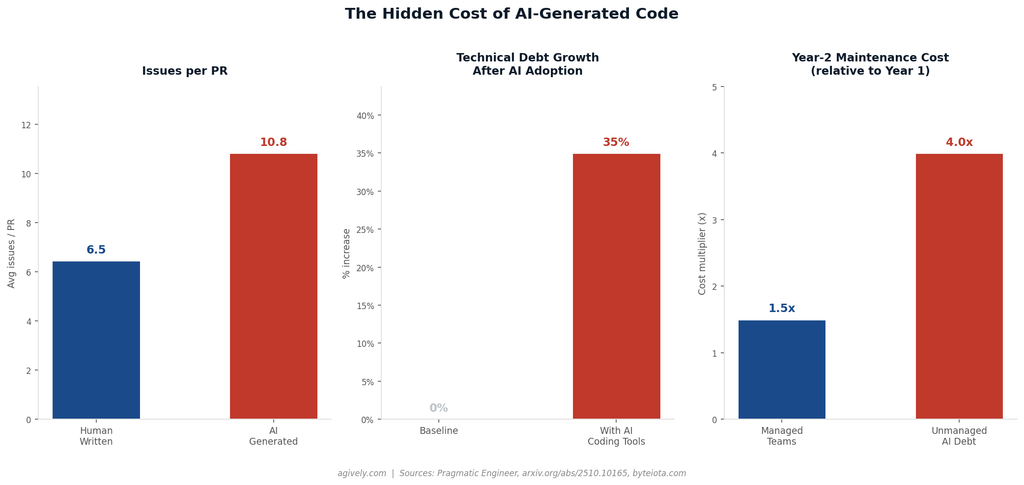
Year two is when the wall hits. Feature velocity slows. Engineers who shipped with confidence twelve months ago are now spending the majority of their cycles on code they half-understand in a codebase that’s structurally harder to reason about than the one they started with. One CTO I spoke with described it this way: “We felt like we’d finally solved hiring. AI let us ship with a smaller team. What we didn’t plan for was that the maintenance load doesn’t scale the same way the shipping does.”
Why AI-Generated Code Accumulates Debt Faster
This is not a failure of the tools. The tools work. The problem is structural, and it comes down to a few patterns that show up consistently.
The code is correct but not coherent. AI coding assistants optimize for solving the problem in front of them. They do not optimize for how that solution fits into the larger system architecture. The result is code that passes its tests, handles its inputs, and produces its outputs, but does so in a way that creates friction everywhere else. Duplicate patterns emerge across the codebase. Abstractions that should be shared get reinvented three times. The logic that handles a business rule lives in four different places, each slightly different, and nobody planned that.
Test coverage is shallow by default. When an engineer uses AI to generate code and asks for tests, the tests generated tend to cover the happy path. The edge cases, the failure modes, the behavior under unexpected inputs: those require a human who understands the business context to identify what needs testing. Most teams don’t stop to do that work. They move to the next feature. The test suite looks healthy and misses the thing that will fail in production.
Context gets lost fast. Human-written code tends to carry the author’s reasoning, if not in comments then in structure and naming. AI-generated code often has technically correct variable names and structure, but it doesn’t carry the “why.” When something breaks six months later and the engineer who used the AI tool has moved on, the new person reading the code has no way to reconstruct the intent. They make a change that looks safe. It isn’t.
Refactoring is harder than it looks. One of the arguments for AI coding tools is that they make refactoring cheap. This turns out to be partially true, and the partial is the problem. Refactoring a well-understood, well-structured codebase with AI assistance is faster. Refactoring a codebase where the AI has generated inconsistent patterns across a year of sprints is significantly harder. The assistant generates solutions that fit the local context. It doesn’t always catch the global inconsistency it’s perpetuating.
The Teams Getting This Right
None of this is an argument against AI-assisted development. It’s an argument against using it without a maintenance strategy. The teams I’ve seen manage this well share a few habits that are worth naming.
They treat AI-generated code the same way they’d treat code from a contractor who might not be around in six months. That means: documentation at the point of generation, not retrospectively. A code review process that asks “can a human on this team explain what this does and why” before it merges. And a regular refactor cycle that’s budgeted into the sprint from day one, not added when the debt becomes impossible to ignore.
They use AI tools for application modernisation deliberately, not reflexively. There’s a difference between using AI to accelerate work that a trained engineer is directing and using AI to replace the judgment that engineering experience provides. The first pattern tends to produce coherent, maintainable code. The second produces code that ships fast and accumulates problems quietly.
They invest in observability before the debt compounds. The teams catching problems early have instrumentation in place that surfaces anomalies before customers do. Logging, tracing, monitoring: these aren’t optional hygiene on a modern AI-powered development stack. They’re the early warning system. And they need a human being who reads what the system tells them, not a dashboard that nobody checks until there’s an incident.
They separate generation from integration. Rather than having individual engineers generate and integrate AI code in a single workflow, some teams have found value in treating the AI output as a draft that goes through a formal integration step. Someone checks the generated code against the architecture, flags inconsistencies, and adds the context layer before it enters the codebase. It’s slower upfront. It’s significantly faster in year two.
What Good Looks Like, Practically
If you’re looking at your current codebase and wondering how much of this applies to you, a few questions worth asking honestly:
Can every engineer on your team explain, in plain language, what any given module does and why it was built that way? If the answer is “mostly yes,” you’re probably in reasonable shape. If the answer is “the people who know are the people who wrote it with the AI,” you have a context problem that compounds over time.
What percentage of your sprint is maintenance versus new development? Industry benchmarks put healthy teams at roughly 20-30% maintenance. If you’re above 40%, you’re already in the debt-compounding phase. If you’re above 50%, you’re in the phase where paying down the debt is the primary job, not shipping new work.
When something breaks in production, how quickly can an engineer who wasn’t involved in writing the code identify the root cause? If the answer is hours to days rather than minutes, your codebase has a coherence problem. And AI-generated code that wasn’t reviewed for coherence at the time of generation is a common driver.
These aren’t questions with easy answers. They’re not meant to be. They’re meant to locate where in the year-two cycle your team actually is, so you can address it before it addresses you.
The Part That’s Actually Hopeful
Teams that are actively managing AI-generated technical debt are not slowing down their AI adoption. They’re changing how they adopt it. The discipline isn’t “generate less.” It’s “generate better and integrate deliberately.”
The teams winning in 2026 are the ones who figured out early that AI tools shift where engineering effort goes, not how much engineering effort the job requires. Shipping fast is easier. Deciding what to ship and how it should fit into a system that exists to serve real users at scale: that still requires experienced humans making judgment calls.
The workflow automation and engineering assistance that AI provides is real. The value is not in doubt. What’s also real is that a production codebase is not a series of individual problems to be solved. It’s a system with history, constraints, and a future that your current team will have to work in. The tools that help you build it faster don’t automatically help you keep it coherent.
Year two arrives for everyone. The difference between teams who hit the wall and teams who don’t is almost never the tools they used. It’s whether anyone stopped, before year one was out, to ask: what are we going to do with all of this code we’re generating?
The teams who asked that question, and built a process around the answer, are the ones still shipping in year three