It’s Tuesday morning. Your head of customer success pings you: “The AI assistant gave a client wrong instructions for our new onboarding flow. They’ve been following the old process for a week.”
You pull up the logs. Everything is green. The model responded in 340 milliseconds. The similarity score was 0.87. The feature worked exactly the way you built it.
It just worked on documents you updated 12 days ago.
This is the RAG production problem. Not the model. Not the latency. The retrieval. And if you haven’t hit it yet, you will — it’s the same demo-to-production gap we’ve written about for agents more broadly in When Your AI Agent Hits Production.
What Everyone Gets Right in the Demo
Retrieval-augmented generation is a genuinely useful pattern. You take your docs, your policies, your product knowledge, chunk them up, embed them into a vector store, and give your AI assistant access to them. The model retrieves relevant chunks and answers based on what it finds. It’s the right answer to “how do we stop the model from hallucinating about our product.”
The demo works every time. You ask it about your pricing, it finds the right chunk, it answers correctly. You ask it about your refund policy, it finds that too. You show the CEO. The CEO is delighted. You ship.
Three weeks later, support tickets arrive.
The model is confident. The retrieval scores are fine. The system is doing exactly what you told it to. And your docs are now wrong.
The Failure Modes Nobody Puts in the Pitch Deck
A 2026 study analyzing 143 enterprise RAG deployments found that 73% experienced at least one critical failure in their first quarter of production. More striking: 41% of those failures were never flagged by standard evaluation suites. The monitoring said everything was fine. The users knew it wasn’t.
Here is where it breaks.
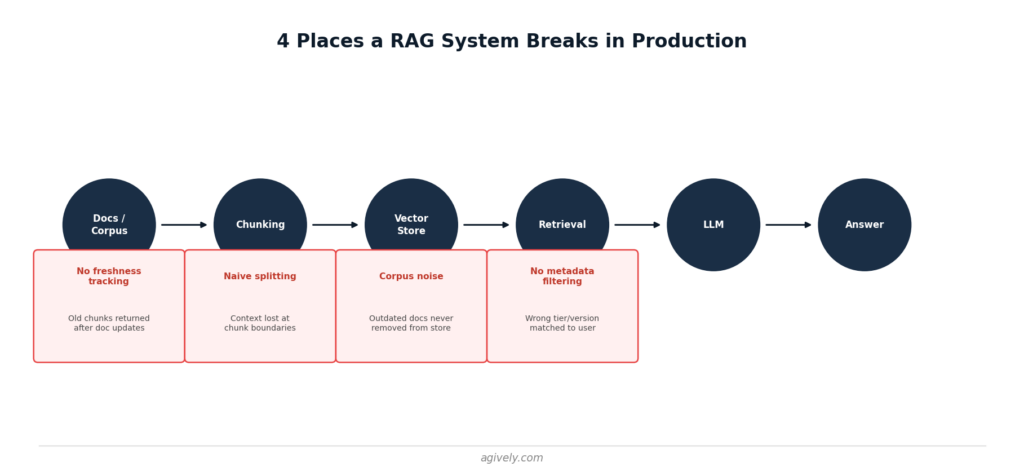
Staleness. Your knowledge base does not know when a document changes. You updated your onboarding guide on June 3rd. The old version is still in your vector store, with a perfectly reasonable embedding score, returning confidently to users. The fix is not obvious because the system has no concept of freshness. It finds what matches, not what is current.
Chunking. Most teams chunk naively: split on paragraph breaks or hit a token limit and cut. This works for self-contained facts. It fails for anything that requires context across a section boundary. The pricing table that spans pages 3 and 4 of your policy document gets split down the middle. The model retrieves half the table. The answer is technically grounded in your documents and completely wrong.
Metadata. A RAG system with no filtering is a system that retrieves from everything equally. If you support three product tiers and a user asks a question specific to the Enterprise plan, you need metadata-aware retrieval that can filter by tier before semantic ranking. Without it, you get the cheapest-tier answer for an Enterprise client. Sounds like a small thing until it involves contract compliance in HealthTech.
Retrieval noise. When your corpus is large enough, semantic similarity stops being a reliable proxy for relevance. You retrieve the top-k chunks by score. Three of them are relevant. Two are topically similar but from an outdated FAQ that was never deleted. The model tries to reconcile all five. The answer is a blend of now and six months ago, served with complete confidence.
Where Teams Make the Mistake
The pattern I see is consistent: the team builds RAG as a feature, not as infrastructure.
A feature has a launch date and a success metric. You ship it, you watch the initial numbers, you move on. Infrastructure has ongoing ownership. Someone watches it, keeps it current, knows when it is drifting. RAG built as a feature behaves like a feature. You launch it, it works, you deprioritize it. Six months later it is confidently lying to your users, and no dashboard is telling you so.
This is the accountability problem more than the technical one. The technical fixes exist. Freshness tracking, metadata-aware retrieval, chunk-level evaluation pipelines, none of these are exotic. What is hard is getting a team to treat a retrieval system the way they would treat a database: as something that needs a schema, needs migrations, needs an owner, and needs monitoring that knows what bad looks like.
“But our retrieval scores are good.” Yes. Your latency metrics are also good. These tell you the system ran. They do not tell you it was right.
What Good Actually Looks Like
A well-built production RAG system is three interlocking things: a retrieval engine, a content management process, and an evaluation pipeline. Most teams build the first one and think they are done.
The content management piece is straightforward but unglamorous. Every document in your corpus needs a source-of-truth location, a timestamp, and an owner. When a document is updated, the old chunks are invalidated and re-embedded. This is not clever engineering. It is the same hygiene you would apply to any database. The only reason teams skip it is that the demo works without it. If you need help building the automation around this, it maps almost directly onto the kind of workflow automation that keeps other business data pipelines from going stale. The problem is not new. The surface it is applied to is.
The evaluation piece is where most teams need to invest more than they expect. You need a set of questions, ideally drawn from real user queries, for which you know the correct answers. You run them against your retrieval system regularly. Not to check that the LLM responded coherently, but to check that the retrieved chunks were actually the right ones. Coherent answers from wrong chunks are the failure mode you cannot detect with standard LLM evals — exactly the blind spot a real evaluation discipline is built to catch.
If you are building in a regulated space, HealthTech or FinTech especially, AI-powered development of a RAG feature should include a documented evidence chain: which chunks were retrieved, from which source version, and at what timestamp. This is not optional if your AI assistant is answering questions about clinical procedures, loan terms, or compliance requirements. It is the audit trail that tells you what the system believed when it gave an answer.
The Cost of Getting This Wrong
RAG failures are expensive in ways that do not show up in your monitoring stack.
They show up in support tickets that your team initially misattributes to user error. They show up in client calls where someone says “your AI told me X” and you have no record of what it actually retrieved. They show up as trust erosion. Users who get one wrong confident answer start answering their own questions instead of asking the system. Your engagement metrics drop. Nobody knows why.
In AI consulting work with startups, one of the first things I ask when a team comes to us with a broken AI feature is: “What is in your vector store right now, and when did you last audit it?” The answer is almost always “we are not sure.” That is not negligence. That is building a feature without building the system around it.
The good news, and there is genuine good news here: teams that get this right have a real competitive advantage. A RAG system with proper freshness management, metadata-aware retrieval, and an evaluation pipeline is not just more reliable than a naive one. It is a capability gap. Your AI assistant actually knows what is true right now, can be audited when it gets something wrong, and improves as your corpus improves. That is not a demo. That is a product your competitors cannot replicate by copying your stack.
Before You Ship the Next AI Feature
If you are about to ship something RAG-powered, or already have, these are the questions worth answering before someone else answers them for you.
Who owns the corpus? Not “who manages the docs” in a general sense. Whose job is it to invalidate and re-embed when a source document changes?
What does retrieval failure look like to you? Not model failure. Retrieval failure. Do you have queries with known-correct answers that you run against your system on a schedule? If not, you are flying blind.
What is your chunk review process? Have you looked at what your system actually retrieves for your ten most common user queries? Most teams have not.
These are not trick questions. They are the same operational discipline you would apply to any piece of infrastructure that handles customer data. The only thing that changed is that the output is natural language, so failure looks like a confident, well-formatted wrong answer rather than a stack trace.
Stack traces are actually easier to catch.